Publications
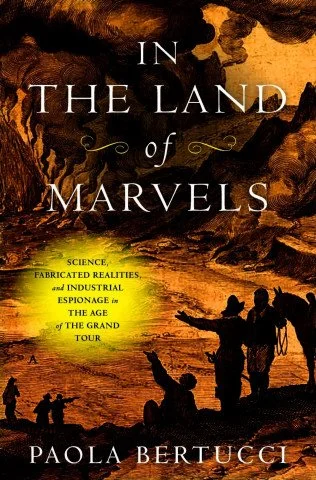
In the Land of Marvels
Science, Fabricated Realities, and Industrial Espionage in the Age of the Grand Tour
Johns Hopkins University Press, 2023
How a journey through Italy casts light on secrets, stereotypes, and the manipulation of information in eighteenth-century science.
Winner of the Paul Bunge Prize by the German Chemical Society
In 1749, the celebrated French physicist Jean-Antoine Nollet set out on a journey through Italy to solve an international controversy over the medical uses of electricity. At the end of his nine-month tour, he published a highly influential account of his philosophical battle with his Italian counterparts, discrediting them as misguided devotees of the marvelous. Paola Bertucci's In the Land of Marvels brilliantly reveals the mysteries of Nollet's journey, uncovering a subterranean world of secretive and ambitious intelligence gathering masked as scientific inquiry.
The advent of electricity was a pivotal phenomenon not only in the history of physical experimentation, but also in the cultivation of popular scientific interest. Nollet's journey was supposedly inspired by the need to investigate, and subsequently report on, claims of the use of electrified "medicated tubes" by their Italian inventor Gianfrancesco Pivati. Motivated by economic interests in the silk industry, Nollet's journey was in fact an undercover mission commissioned by the French state to discover the secrets of Italian silk manufacture and possibly supplant its international success. The event that sparked the medical controversy—the unusual cure of a bishop—was a complete fabrication.
Bertucci insightfully contrasts published accounts of the event with private documents and discusses how eighteenth-century scientists published fictional events and results to bolster their careers, ultimately leading to long-lasting misrepresentations of scientific practice and enduring stereotypes. In the Land of Marvels reveals the constellation of historical actors, from reputed physicists to travel writers and electrical amateurs, who manipulated information to gain authority and prestige.
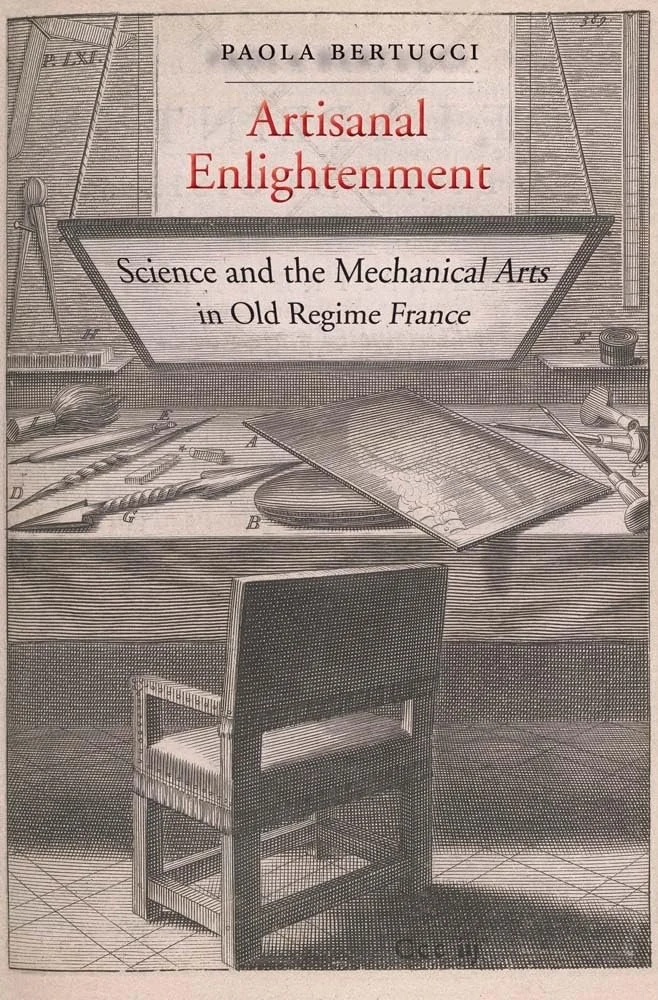
Artisanal Enlightenment
Science and the Mechanical Arts in Old Regime France
Yale University Press, 2017
A groundbreaking work that places the mechanical arts and the world of making at the heart of the Enlightenment
Winner of the Louis Gottschalk Prize by the American Society for Eighteenth-Century Studies
What would the Enlightenment look like from the perspective of artistes, the learned artisans with esprit, who presented themselves in contrast to philosophers, savants, and routine-bound craftsmen? Making a radical change of historical protagonists, Paola Bertucci places the mechanical arts and the world of making at the heart of the Enlightenment. At a time of great colonial, commercial, and imperial concerns, artistes planned encyclopedic projects and sought an official role in the administration of the French state. The Société des Arts, which they envisioned as a state institution that would foster France’s colonial and economic expansion, was the most ambitious expression of their collective aspirations.
Artisanal Enlightenment provides the first in-depth study of the Société, and demonstrates its legacy in scientific programs, academies, and the making of Diderot and D’Alembert’s Encyclopédie. Through insightful analysis of textual, visual, and material sources, Bertucci provides a groundbreaking perspective on the politics of writing on the mechanical arts and the development of key Enlightenment concepts such as improvement, utility, and progress.
Viaggio nel paese delle meraviglie
Scienza e curiosità nell'Italia del Settecento
Bollati Boringhieri, 2007
Nel 1749 Jean Antoine Nollet si mette in viaggio per l’Italia, ufficialmente per conto dell’Accademia delle Scienze di Parigi, di cui è membro. L’istituzione lo incarica di scrivere un rapporto sulle guarigioni prodigiose che alcuni italiani sostengono di poter effettuare ricorrendo alla scienza del secolo, l’elettricità. A sud delle Alpi il francese entra in contatto con una società in cui l’ “elettricismo” è una moda dilagante: scintille e attrazioni animano le serate nei salotti e nelle corti, appassionando le dame e accendendo le ambizioni di accademici ansiosi di guadagnare fama e prestigio. Da Torino a Napoli, i suoi incontri con i circoli intellettuali locali offrono un originale spaccato della vita scientifico-culturale italiana, in cui anche diverse donne sono protagoniste di primo piano. Ricostruendo le tappe di un viaggio che diventerà l’emblema dello scontro tra l’ “amore del meraviglioso” e l’ “amore della verità” - cioè tra superficiale credulità e rigorosa ricerca sperimentale - questo libro fa luce su un personaggio-chiave e su un momento cruciale della scienza sperimentale settecentesca. L’autrice esplora le molteplici sfaccettature del rapporto tra scienza e meraviglia nell’età dell’Illuminismo e documenta aspetti inediti del viaggio che invitano a riflettere sugli stretti legami della scienza con la politica e l’economia. La missione scientifica ufficiale copre infatti un’operazione di spionaggio industriale sulla manifattura dei filati di seta, commissionata dallo stato francese e resa possibile dalla collaborazione di insospettabili italiani.
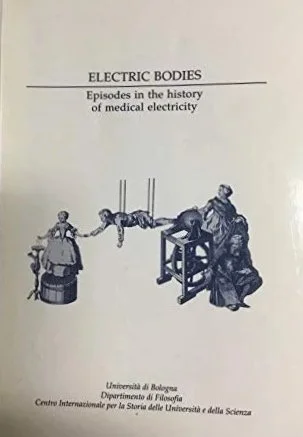
Electric Bodies
Episodes in the History of Medical Electricity
CIS, University of Bologna, 2001
co-edited with Giuliano Pancaldi
Most Recent Articles and Book Chapters
“The Silences of the Collection: Displaying Scientific Heritage and the History of Science and Medicine at Yale” in Scientific Instruments as Cultural Artifacts edited by Paola Bertucci and Alexi Baker, Yale University Press (forthcoming, 2027).
“Spinners Hands, Imperial Minds: Migrant Labor, Embodied Expertise, and the Failed Transfer of Silk Technology across the Atlantic,” Technology and Culture 62 (2021), 1003-1031.
“Shocking Subjects. Human Experiments and the Material Culture of Medical Electricity in Eighteenth-Century England,” in Erika Dick and Larry Stewart (eds), The Uses of Humans in Experiment: Perspectives from the 17th to the 20th Century (Leiden and Boston: Brill, 2016).
“Artisanal Knowledge, Expertise, and Patronage in Early 18th-Century Paris: The Société des Arts,” Eighteenth-Century Studies 48 (2015), 159-179 (with Olivier Courcelle).
“Enlightened Secrets: Silk, Industrial Espionage, and Intelligent Travel in 18th-century France,” Technology and Culture 54 (2013): 820-52.
Winner of the 2015 Clifford Prize from the American Society of Eighteenth Century Studies.
“The In/visible Woman: Mariangela Ardinghelli (1730-1824) and the circulation of natural knowledge between Paris and Naples,” Isis 104 (2013): 226-49.
Winner of the Margaret Rossiter Prize for best article on the history of women in science published in the previous four years, awarded by the History of Science Society.